How Does a Septic Tank Work? What Happens Inside the Tank
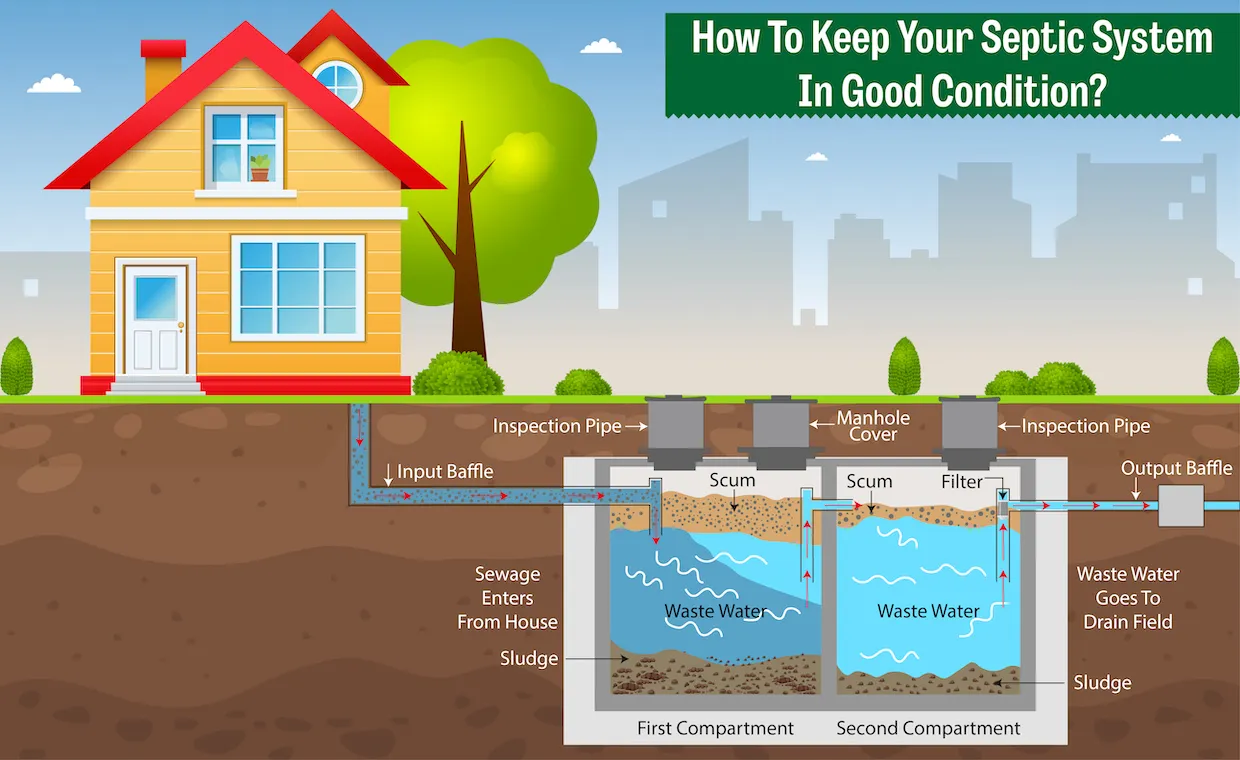
A septic tank holds waste water long enough for solids to sink and fats to float, then lets the liquid in the middle flow out to a drainage field. Here is what happens at each stage, and how each failure shows up.
A septic tank works by holding the waste water from your house long enough for it to separate. Heavy solids sink to the bottom as sludge, fats and light material float to the top as a crust, and bacteria slowly break some of the solids down. The clearer liquid in the middle flows out of the far end of the tank into a drainage field or soakaway, where the soil finishes treating it. Nothing is pumped and nothing is powered: it all runs on gravity and time. Knowing that sequence tells you what has gone wrong when one starts to smell, back up or overflow.
What happens when you flush: the journey through a septic tank
Everything that goes down a toilet, sink, bath or appliance on the property flows through one drain to the tank. From there it passes through three stages: settling in the tank, a slow partial breakdown by bacteria, and final treatment in the ground.
The drain from the house enters the tank near the top through an inlet pipe. Because the tank is already full of liquid up to the level of its outlet, every litre that comes in pushes roughly a litre out of the other end. That is the key point most owners miss: a working septic tank always looks full. The level only matters if it rises above the outlet, which means the liquid has stopped leaving. A cesspit is different because it has no outlet at all; our guide to cesspits, septic tanks and treatment plants explains how to tell which one you have.
Sludge, scum and the liquid in between
Inside the tank the waste settles into three layers. Sludge sits on the bottom, scum floats on top, and the partly clarified liquid, called effluent, sits in the middle and is the only part meant to leave.
- Sludge. Heavier solids such as faeces, food particles and grit sink and build up on the floor of the tank. Bacteria digest some of it, but not all, so the layer grows steadily. This is what the tanker removes when a septic tank is desludged.
- Scum. Fats, oils, soap residue and anything light enough to float form a crust across the surface. A thick crust is normal. A crust that reaches down to the outlet is not.
- Effluent. The liquid between the two layers. It looks clearer than raw sewage, but it is still polluted and still carries bacteria, which is why it has to go into the ground rather than a ditch or stream.
The bacteria that do the work live without oxygen, so the process is slow and only partial. A septic tank reduces and separates sewage; it does not clean it. That is also why a septic tank smells of rotten eggs when it is opened: the gases produced include hydrogen sulphide and methane, and they collect in the space under the lid.
Why a septic tank has two chambers and dip pipes
Most septic tanks are split into two chambers, and the pipes into and out of each one dip below the surface. Both features exist to stop solids and scum escaping to the drainage field.
The first chamber takes the incoming flow and does most of the settling. Liquid passes through a gap or pipe in the dividing wall into the second chamber, where finer solids get a second chance to settle before the outlet. The inlet and outlet are usually fitted with T-shaped pipes or baffles that reach down into the liquid. The inlet T stops incoming waste stirring up the scum layer, and the outlet T draws liquid from the middle of the tank, below the scum and above the sludge. If an outlet T-piece breaks or falls off, scum and solids can pass straight out, and the first sign is usually a drainage field that starts to fail years before it should.
Where the liquid goes: the drainage field
The effluent leaving the tank runs into a drainage field: a network of perforated pipes laid in gravel trenches under the lawn. It seeps out into the soil, where bacteria that need oxygen and the soil itself filter and treat it.
This is the half of the system owners forget, and the hardest to put right. Some older properties have a single soakaway pit instead of a proper drainage field, which does the same job with far less ground and fails sooner. Either way, the ground has to keep accepting water. Soil that becomes clogged with fine solids, compacted by vehicles, invaded by roots or waterlogged after weeks of rain stops taking the effluent, and it backs up into the tank. Since 2020, in England, a septic tank is not allowed to discharge directly into a river, stream or ditch; it must go to a drainage field or be upgraded to a treatment plant.
What stops a septic tank working, and what each failure looks like
This section explains failures in terms of how the tank works; for the warning signs to watch for across both tanks and soakaways, see our septic tank and soakaway warning signs guide.
Almost every septic tank problem is one of four things: too much sludge, a blocked pipe, a failed drainage field or too much water going in. Each shows up differently, which is how an engineer works out which one you have.
- Sludge left too long. The sludge and scum layers grow until solids start leaving with the effluent and clog the drainage field. There may be no symptom at all until the field fails, which is why regular desludging, usually about once a year for a household, matters more than waiting for a sign.
- Blocked inlet pipe. Toilets and sinks in the house back up, but the level in the tank is normal. That is a drain clearance job, not an emptying.
- Blocked outlet or failed drainage field. The level in the tank is above the outlet, the ground over the field is soggy or smelly, and the tank refills quickly after it has been emptied.
- Too much water. A running toilet cistern, a leak or a rainwater downpipe connected by mistake pushes liquid through faster than solids can settle, carrying them out to the field.
If sewage is already backing up indoors or surfacing in the garden, go straight to our guide on what to do when a septic tank is full or overflowing.
What should and should not go into a septic tank
A septic tank copes with toilet waste, toilet paper and normal household waste water. It struggles with anything that does not break down, anything that floats in large amounts and anything that kills its bacteria.
- Keep out: wet wipes, including those labelled flushable, sanitary products, nappies, cotton buds, cooking fat and oil, and food scraps. They add to the sludge and scum faster than bacteria can deal with them.
- Use with care: bleach, disinfectant and caustic drain unblockers. Normal cleaning in normal amounts is fine; pouring large quantities down at once can kill off the bacteria for a while.
- Do not connect: roof water and surface water from yards or driveways. They should go to a separate soakaway, not through the tank.
- Not needed: septic tank additives and treatments. A tank that is sized correctly and desludged regularly does not need them, and none of them replaces emptying.
One safety rule matters more than any of these. Never climb into a septic tank or put your head into the opening, even when it has just been emptied. The gases inside can overcome a person in seconds. Keep lids secure and in good repair, particularly where children play.
When to call someone, and when it can wait
A septic tank that is due its annual desludge but showing no symptoms can be booked in normal working hours. A tank backing up into the house, or sewage surfacing near the house or running off your land, needs dealing with the same day.
Most septic problems are not night-time emergencies, and waiting for a standard-hours slot is usually cheaper. We charge by time band, 7am to 5pm, 5pm to midnight and midnight to 7am, and the figures are on the pricing page. When you book a septic tank emptying, tell us the tank type, roughly how far it is from where a tanker can park, and when it was last emptied. If the tank refills soon after emptying, say so, because that points to the drainage field rather than the tank.
Frequently asked questions
Does a septic tank need electricity?
No. A conventional septic tank runs entirely on gravity: waste flows in, settles, and the liquid flows out to the drainage field. If your system has a pump, blower or control panel, it is either a sewage treatment plant or a septic tank with a pumped outlet, and it needs its electrics checked when anything goes wrong.
Is it normal for a septic tank to look full?
Yes. A working septic tank is always filled up to the level of its outlet pipe, because each litre coming in pushes a litre out to the drainage field. It is only a problem if the liquid is above the outlet, or if the tank fills back up quickly after it has been emptied.
How long does the waste stay in a septic tank?
The liquid passes through over a period of hours to a day or so, depending on the tank's size and how much water the household uses. Solids stay much longer: they build up as sludge until the tank is desludged, which for most households is about once a year.